Is the product real?
Yes. ClickBank currently lists Energy Revolution System under the nickname
enrev in the Alternative Energy category. The offer is described as
a digital product containing plans/instructions rather than a finished generator.
A lower-cost way to experiment with energy for independency?
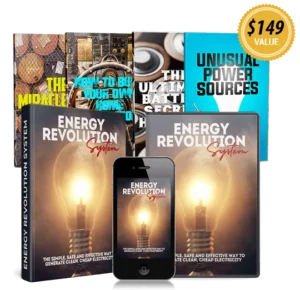
The Energy Revolution System is a DIY project, not a ready-made power generator. The plans cost around $149, but the physical build may require another $150–$250+ in components. If you’re expecting instant, guaranteed electricity savings, stop here. If you’re willing to build, test, and judge the results for yourself, keep reading.
First question: Is the historical Tesla connection real, and does it prove the modern product claims? We answer both separately.
Affiliate disclosure: We may earn a commission if you purchase through links on this page. This does not change our editorial assessment or the price you pay.
Move cursor · 360°
The most important thing to understand is that several different questions are being mixed
together in the marketing. We separate them.
Yes. ClickBank currently lists Energy Revolution System under the nickname
enrev in the Alternative Energy category. The offer is described as
a digital product containing plans/instructions rather than a finished generator.
Yes. U.S. Patent 512,340, “Coil for electro-magnets,” was granted to Nikola Tesla
in 1894. It discusses adjacent insulated conductors, capacitance and self-induction.
No. A genuine historical patent and a modern DIY implementation are different things.
The product’s specific performance claims require measurements of the actual build,
input energy, output energy, loads and operating conditions.
The appeal is easy to understand: electricity is an ongoing household expense, outages
create inconvenience, and conventional backup or renewable-energy systems can require
significant hardware investment.
Wanting lower electricity costs is not evidence that a particular device can deliver
them. The right question is:
How much usable electrical energy does the actual system deliver, under what
input conditions, at what total cost, and for how long?
Public promotional pages consistently describe the offer as a digital program. That means
the purchase should be evaluated like an instructional product, not like a boxed generator.
This is where many promotional explanations become blurry. The historical record is
straightforward, but the leap from a 19th-century patent to a modern household power
system requires additional evidence.
U.S. Patent 512,340, titled Coil for electro-magnets, was granted to Nikola Tesla
on January 9, 1894. The patent describes a coil made from adjacent insulated conductors
connected in series and discusses increasing capacitance in relation to self-induction.
Read the
original patent record at Google Patents →
The product is promoted around a Tesla-inspired bifilar or “pancake” coil concept. To
understand the claim, you first need to separate ordinary electromagnetic principles from
the product’s specific performance claims.
Electrical systems can convert energy between forms. Generators, motors, transformers,
inductors and resonant circuits all use electromagnetic relationships, but they do not
eliminate the need for an energy source.
In a bifilar arrangement, two conductors are wound closely together. Tesla’s patent
discusses using adjacent conductors to increase the coil’s effective capacitance and
alter its electrical behavior in relation to self-induction.
This is the question a serious review must force into the open. If a device claims to
produce usable electrical power, the analysis needs to identify the energy input and
measure it. A circuit can store, transfer, transform or temporarily release energy;
those processes do not establish creation of net energy from nothing.
The U.S. Department of Energy’s fundamentals material states the conservation principle
directly: energy is transferred or transformed rather than simply appearing or disappearing.
Explaining electromagnetic principles does not establish the performance of the Energy
Revolution System. A modern build needs its own measurements, circuit configuration,
component specifications and repeatable load testing.
This table is deliberately blunt. A claim can be commercially prominent and still remain
unverified by independent evidence.
| Claim or statement | Status | How we interpret it |
|---|---|---|
| Energy Revolution System is a ClickBank offer | Verified | ClickBank currently lists the offer as ENREV in Alternative Energy. |
| The program is digital | Supported | Public product pages describe downloadable/online plans and instructions. |
| It uses a Tesla-inspired bifilar coil concept | Product claim | The historical Tesla patent is real; the modern implementation is a separate question. |
| Electricity bills can fall by 50–80% | Marketing claim | Public promotional pages make this claim, but it should not be treated as a universal result. |
| Electricity bills can fall by as much as 88% | Marketing claim | ClickBank’s current promotional material repeats an “up to 88%” claim. It is not independent proof of typical results. |
| It can power an entire home | Needs testing | Household loads have very different continuous and startup requirements. |
| It is safe for anyone to build | Do not assume | DIY electrical construction can involve shock, fire, short-circuit and wiring hazards. |
The absence of independent verification is itself useful information. These are the claims we would not present as established facts without reproducible evidence.
The only useful way to discuss savings is to translate percentages into actual dollars and
then ask whether the claimed output has been independently demonstrated.
| Monthly electricity bill | 10% reduction | 25% reduction | 50% reduction | 80% reduction | 88% reduction |
|---|---|---|---|---|---|
| $100 | $10 | $25 | $50 | $80 | $88 |
| $150 | $15 | $37.50 | $75 | $120 | $132 |
| $200 | $20 | $50 | $100 | $160 | $176 |
| $300 | $30 | $75 | $150 | $240 | $264 |
A bill reduction can come from many sources: lower consumption, changing loads, shifting
usage, adding another energy source, or actually generating electricity. A credible test
needs to isolate the contribution of the device itself.
Comparing a digital guide price with the price of a finished solar system is misleading.
The correct comparison is the total cost of building, measuring, operating and maintaining
the system.
Current promotional versions describe the build as beginner-friendly and suggest that
assembly can be completed in a few hours. Those statements are marketing claims about
usability, not a guarantee that every buyer will complete a safe, working system in
the same amount of time.
A clear diagram can make a construction sequence easier to follow. It does not remove the
electrical hazards associated with incorrect connections, inadequate insulation, overloaded
conductors, stored energy, batteries, inverters or connection to household wiring.
Safety is not a marketing feature. It is a property of the actual circuit, components,
enclosure, protection devices, environment and installation.
Exposed conductors, incorrect insulation, energized circuits and mains connections
can create serious shock hazards.
Undersized wires, poor connections, excessive current and inadequate protection can
generate heat and create fire risk.
Batteries, capacitors and inductive circuits can retain energy after the main source
has been disconnected.
Do not connect a DIY experimental device directly into a home’s fixed electrical wiring
unless the installation has been designed and approved in accordance with applicable local
electrical requirements. Where mains voltage, transfer switches, panels, grounding or
grid-connected equipment is involved, use a qualified electrician.
Do not answer this with a vague “yes.” Every appliance has a power requirement, and some
loads have large startup surges.
| Load | What matters | How we would evaluate it |
|---|---|---|
| Phone charger | Low continuous demand | Measure usable output under load. |
| LED lighting | Low demand, long duration | Measure watt-hours over a defined period. |
| Laptop | Moderate continuous demand | Measure real input/output rather than relying on labels alone. |
| Fan | Moderate load | Test continuous operation and temperature. |
| Refrigerator | Startup surge + cycling | Measure startup and running demand separately. |
| Air conditioner | High demand + startup surge | Requires substantial measured output and proper protection. |
| Electric heater | Very high continuous demand | Do not assume a small DIY system can support it. |
A device can show a voltage reading and still fail to deliver useful energy to a load.
You need voltage, current, power and energy measurements under actual operating conditions.
If we ever publish a hands-on test, this is the standard we would use. The goal is not to
“prove” or “disprove” the product in advance. The goal is to measure it honestly.
Stronger evidence would include an independently reproducible build, calibrated measurement
equipment, clearly documented input and output energy, repeated tests, controlled loads and
enough data to rule out measurement artifacts. A testimonial or a voltage reading is not the
same thing.
The web contains many “official” or affiliate-style pages repeating similar claims. That
repetition should not be mistaken for independent corroboration. A claim copied across
multiple promotional pages remains one underlying marketing claim unless each source has
independently tested it.
| Factor | DIY blueprint approach | Solar + battery |
|---|---|---|
| Initial information cost | Low | Higher hardware investment |
| Physical hardware | Purchased separately | Purpose-built equipment |
| Industry maturity | Needs product-specific testing | Mature technology and established installers |
| Weather dependence | Depends on actual energy source/design | Solar generation varies with sunlight |
| Installation | DIY/technical | Often professionally installed |
| Evidence base | Product-specific evidence needs scrutiny | Large established technical literature |
A conventional generator has a clearly identified energy source: fuel. Its electrical
output can be specified in watts and tested under loads. It also has known maintenance,
noise, emissions and fuel-storage tradeoffs. A DIY experimental system should be compared
using the same measurable criteria rather than marketing language.
Portable power stations are generally evaluated by battery capacity, continuous AC output,
surge output, charging options, cycle life and warranty. A DIY system should be evaluated
by actual measured output and total project cost before claiming it is a better alternative.
The cheapest kilowatt-hour is often the one you never need to purchase. Efficiency measures,
load management and appliance upgrades should be part of the decision, especially if the
goal is simply to lower the monthly bill.
No. The public offer is presented as a digital program/blueprint. Buyers
should expect instructions and digital materials, not a finished generator arriving by mail.
Yes. The patent record is public and identifies Nikola Tesla as inventor.
The patent should be read for what it actually describes, not for claims added by modern
marketing.
No. Historical authenticity and modern performance are separate evidence
questions.
The answer depends on what you think you are buying. If you see it as a low-cost digital
DIY project that teaches a particular electrical concept, the purchase proposition is very
different from treating it as a proven replacement for solar, a generator or the electrical grid.
You are paying for instructions, diagrams and a project concept that you can evaluate,
build and measure.
You expect the system to automatically deliver a dramatic household bill reduction
without substantial testing or engineering.
Treat the marketing claims as hypotheses. Verify the actual build, output, safety and
economics before relying on it.
Energy Revolution System is an interesting digital DIY energy product with a genuine
historical Tesla-coil reference point. The weak link is not the existence of Tesla’s patent;
it is the jump from that historical electrical concept to specific modern claims about
electricity generation and household bill reductions.
We therefore would not describe an 80% or 88% electricity-bill reduction as a typical,
independently established result. We would describe it as a promotional claim that should
be tested against the actual build and household conditions.
The vendor page contains the live package, current pricing, checkout details and the
seller’s complete presentation. Verify the exact terms before purchasing.
Affiliate disclosure: This is an affiliate website. If you purchase through
our tracked link, we may receive a commission. We do not claim that this creates an independent
endorsement of the product.
Energy Revolution System is promoted as a digital instructional product. Public promotional pages have recently shown several discounted prices, including roughly $39, so the live ClickBank checkout should be treated as the final source for today’s price and terms.
Check Live Price & Get Instant Access →
The digital purchase is only the first part of the project. If you intend to build the system, budget separately for components, tools, measuring equipment, protective equipment, possible replacement parts and any professional electrical work.
It is marketed as a digital DIY energy program containing plans, diagrams and instructions for building an energy-related device. It is not presented as a conventional boxed generator.
No. Public promotional pages describe digital access to blueprints, manuals and related materials. You should expect to source construction components separately.
The product is marketed around a Tesla-inspired bifilar/pancake-coil concept. Tesla’s U.S. Patent 512,340 from 1894 is genuine and discusses a coil arrangement involving adjacent insulated conductors, capacitance and self-induction.
No. The patent establishes a historical electrical invention. It does not establish the performance of a modern product or a particular household savings percentage.
The vendor and ClickBank promotional materials make large savings claims. We treat those as claims rather than universal outcomes because actual savings depend on the device’s measured output, household consumption, operating conditions and other factors.
Those figures appear in current promotional material, but they should not be interpreted as a guaranteed or typical result. A credible claim would require controlled, repeatable measurements of the actual system and the household energy baseline.
Public promotional pages currently show discounted prices around $39, with some pages displaying a $149 regular price. Because promotions change, verify the live checkout price before purchasing.
The product is a digital guide/program. Construction materials and tools should not be assumed to be included unless the live offer explicitly says so.
Promotional pages describe builds as taking a few hours, but actual time will vary with the design, tools, component availability and the builder’s experience. Treat the advertised build time as a marketing estimate, not a guarantee.
DIY electrical construction can involve shock, fire, short-circuit, stored-energy and wiring hazards. Safety depends on the actual circuit and installation. Do not connect an experimental build to household wiring without appropriate engineering and qualified professional involvement.
Do not assume that. Whole-home power requires enough continuous output, startup surge capacity, protection and compliant installation. The correct answer requires measured system capacity and a defined load profile.
It should not be described as a proven replacement without comparable performance, cost, safety, warranty and reliability data. Solar is a mature technology with a large established evidence base; this product needs to be evaluated on its own measurements.
That depends on actual measured output, runtime, load capacity, safety and reliability. A fuel generator has a defined energy source and rated output. A DIY system should be held to the same practical standard.
The offer itself is currently listed by ClickBank, and public pages describe a digital product with a money-back guarantee. Legitimacy of the transaction is separate from whether every technical or savings claim is independently established.
We would not make that conclusion merely from the product’s marketing claims. A better approach is to separate verifiable facts, vendor claims, technical evidence and unanswered questions. Buyers should avoid treating promotional claims as proof.
Current promotional pages advertise a 60-day money-back guarantee. Check the live checkout and the official purchase terms for the exact conditions applicable to your transaction.
ClickBank currently lists the offer under the nickname ENREV. Our affiliate button sends you to the seller’s current sales/checkout path through our tracked HopLink.
If you are buying it as an inexpensive DIY research/build project and understand the limitations, the decision is different from buying it because you expect a guaranteed 80–88% electricity reduction. Evaluate the total project cost, safety requirements and evidence before deciding.
The purpose of this page is not to repeat a vendor’s sales copy. It is to help a reader
understand what is known, what is claimed, what is uncertain and what would need to be tested.
| Label | Meaning |
|---|---|
| Verified | Supported by a primary or authoritative source. |
| Supported | Consistent with multiple credible sources but not necessarily product-specific. |
| Vendor claim | Statement made in promotional material; not automatically independently verified. |
| Needs testing | Question requires direct measurement or reproducible evaluation. |
| Unknown | Insufficient reliable evidence to make a responsible conclusion. |
The Final Question
The answer depends less on the marketing promise
and more on what you actually expect from the product.
Your mindset
“I’ll investigate it and test it.”
BUY
DON’T
Your mindset
“I need guaranteed results.”
The Real Decision
Don’t buy the promise.
Decide whether you’re comfortable buying
the experiment.
The Bottom Line
Energy Revolution System may make sense as a
low-cost DIY experiment. It should not be treated
as a proven replacement for solar, a conventional
generator, or your home’s electricity supply.
Buy it for the experiment,
not for the guarantee.
If your primary objective is to investigate a
low-cost DIY electrical concept, the proposition
is reasonable to consider. If your objective is
guaranteed energy savings or dependable household
power, this is the wrong product to rely on.
Overall fit
Conditional